Why The Perfect Kitchen Doesn’t Exist
Every homeowner I’ve ever worked with has come to that first design meeting with a picture in their head. A version of their kitchen that’s clean, calm, beautifully lit, and somehow never has washing-up in the sink. I get it… I’ve got that picture in my head too, if I’m honest.
Here’s the thing, though. After more than a decade of designing kitchens for real people with real lives, I can tell you the “perfect kitchen” doesn’t exist. Not because good design doesn’t matter, but because perfection was never really the point.
This isn’t me being cynical. It’s actually a more useful way to think about your renovation, because chasing perfection is how people end up disappointed with a kitchen that costs them tens of thousands of pounds. Chasing the right fit is how they end up loving it.
Let’s get into why.
In a hurry? Here’s my key takeaway:
🏡 A “perfect” kitchen is a fantasy built on a photograph; a genuinely good kitchen is a series of honest trade-offs, made deliberately, for the way you actually live.
Read on to learn more…
You May Also Like
The End Of The White Kitchen? – Why Colourful Cabinets Are Replacing White
We’re Often Chasing A Photo, Not A Kitchen
Most of us don’t build our mental “dream kitchen” from scratch. We build it from other people’s kitchens. Pinterest boards, Instagram reels, glossy magazine spreads, the kitchen a friend just had done…
The trouble is, a photograph is a kitchen with no one in it. No dinner half-made, no school bags dumped on the island, no bin that needs taking out. It’s styled for a single, silent moment, not for a Tuesday morning at 7.15 am.
I always tell clients that the kitchens they’re pinning are aspirational by design. That’s fine as a starting point for style and mood. But if you try to recreate that stillness in a kitchen that four people, a dog, and a weekly food shop actually pass through, you’re setting yourself up to feel like you’re failing at your own kitchen. You’re not failing. The photo was never real life to begin with.
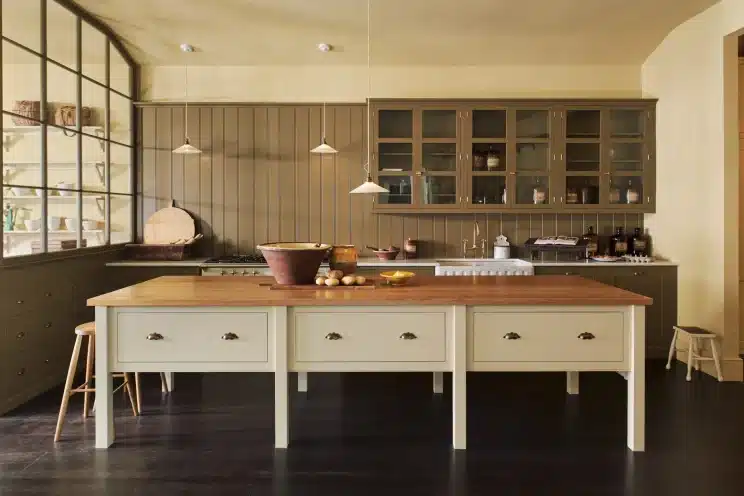
💡 Designer tip: Use inspiration images for colour, material, and mood, not as a literal blueprint. Ask yourself what you actually like about an image (the light? the tones? the hardware?) rather than trying to copy it wholesale.
The Old Rules Were Built For A Different Kitchen
A lot of the “correct” kitchen design people still measure themselves against comes from somewhere surprisingly specific: research from the 1940s.
The classic sink-cooker-fridge “work triangle” was formalised by the University of Illinois’s Small Homes Council in the late 1940s, building on earlier time-and-motion studies into household work. It was designed to make a single cook’s life more efficient in a small, enclosed kitchen. That’s a very different brief to what most of us actually want from a kitchen now.

Today’s kitchens are cooked in by more than one person, used for homework, laptop admin, coffee catch-ups, and the odd episode of chaos when everyone wants the fridge at once. A layout rule built for one person, one job, in the 1940s was never going to comfortably describe all of that.
I’m not saying the work triangle is wrong. The underlying idea, keeping your key zones close enough to avoid pointless walking, still holds up. But it’s a starting principle, not a finish line. Most of the kitchens I design now are planned in zones (prep, cooking, cleaning, storage, and often a separate “everything else” zone for the kettle, toaster, and school-morning chaos) rather than one rigid triangle.
Trends Move Faster Than Kitchens Do
Here’s a genuinely tricky problem with chasing “perfect”: perfect is a moving target. What looked flawless five years ago can look dated today, and what looks flawless today will likely look dated in another five.
I’ve read interviews with interior journalists who’ve renovated three or four kitchens across their career, and the pattern is telling. The features they regret aren’t usually the ones that were badly built. They’re the ones that were on-trend at the time and stopped working once the trend passed or once daily life tested them properly.
Integrated fridges that looked seamless but held less shopping. Chef-style taps with dramatic pull-down sprayers that soaked the backsplash every single day. Dark, moody cabinetry that looked incredible in photos and showed every fingerprint in person.
None of those choices were mistakes exactly. They were honest trade-offs that the buyer didn’t fully weigh up at the time… style for capacity, drama for practicality, mood for maintenance. That’s the real lesson. Trends aren’t the enemy, but treating a trend as a permanent fact about your kitchen usually is.
💡 Pro tip: Before you commit to a strongly trend-led finish (dark cabinets, high-shine gloss, a statement tap), ask how it performs on a bad day, not a good one. Does it show fingerprints? Does it need daily wiping? Is it hard to source replacement parts for in ten years?
Every Choice You Make Is A Trade-off
This is the part people find hardest to hear, but it’s the most useful thing I can tell you: there’s no such thing as a kitchen decision without a trade-off. Every “yes” to one thing is quietly a “no” to something else.
| You choose… | You gain | You give up |
|---|---|---|
| Open shelving | Light, airy feel, easy access | Everyday dust and visible clutter |
| Handleless cabinets | Sleek, minimal look | Slightly less finger-friendly for young kids or arthritic hands |
| Marble countertop | Beautiful, natural surface with real depth | More prone to scatches, stains and etching |
| An integrated fridge | Seamless cabinetry line | Less interior capacity for the same footprint |
| Gloss cabinet finishes | Clean, modern look | Shows fingerprints and marks |
None of the “gains” or “losses” in that table are universally right or wrong. They’re only right or wrong for your household. A couple who barely cook will feel differently about worktop space than a family who bakes every weekend. A downside for one client is a complete non-issue for another.
In my own design projects, I try to get clients talking about their actual week rather than their ideal week. What do you cook on a Tuesday? Who unloads the dishwasher? Does anyone do homework at the island? Those answers matter more than any trend board.
What The Regret Surveys Actually Tell Us
If you want proof that “perfect” isn’t really achievable, you don’t need my opinion. You can look at what people say once they’re actually living in their new kitchen.
Which? surveyed more than 400 of its members about their kitchen renovation regrets, and the top complaints weren’t really about style at all. Flooring that was hard to keep clean came out on top, with storage, worktop space, and cabinet finishes that show marks more than expected also high on the list.
A separate survey of 2,000 British homeowners by kitchen retailer Magnet found similar patterns: not enough power sockets, not enough lighting, wishing they’d fitted a pantry.
What strikes me about both surveys is how ordinary the regrets are. Nobody’s writing in to say their kitchen wasn’t dramatic enough. They’re saying they wish they’d chosen easier-to-clean flooring, or put a socket by the toaster.
Perfect, in other words, was never really about the big showpiece decisions. It was about the small, unglamorous ones that only reveal themselves once you’re living with the space.
💡 Designer tip: When you’re planning, don’t forget to consider things like sockets, bin storage, and lighting layers. These are the choices that quietly make or break how a kitchen feels to use day to day.
Your Kitchen Has To Fit A Life That Keeps Changing
Even if you could design a kitchen that was perfectly suited to your life today, your life won’t stay still. Kids grow up and stop needing a low-level snack drawer. A couple who cooked separately might start cooking together. Someone’s mobility might change. You might start working from home and suddenly need a corner of the kitchen that doubles as a desk.
A kitchen designed to be “perfect” for one specific moment in your life is, almost by definition, going to feel less perfect a few years down the line. That’s not a design failure. It’s just what happens when a fixed thing has to serve a life that isn’t fixed.
This is why I tend to push clients toward flexibility rather than a rigid, hyper-specific ideal. Deep drawers that can hold different things over time. A layout that doesn’t box you into exactly one use for every surface. Storage that can be reorganised without ripping anything out. It’s a genuinely practical way to future-proof a space you might live with for fifteen or twenty years.

So What Should You Actually Aim For?
If perfect isn’t the goal, what is? In my opinion, it’s fit.
A kitchen that fits how you actually cook, how your household actually moves, and what you can actually afford to maintain, both financially and in terms of daily effort.
That means being honest about your habits rather than the habits you’d like to have. If you’ve never once used a proper larder in your life, don’t design one in because it looks good in photos. If you always eat standing at the island rather than at a table, plan seating there properly instead of squeezing in a table you’ll never use.
It also means accepting that you’ll get some things wrong. Every kitchen I’ve ever designed, including my own, has at least one thing I’d tweak with hindsight. That’s not a failure of planning. It’s just what happens when you’re designing for a life you haven’t fully lived yet.
💡 Pro tip: When you’re torn between two options, ask which one you’d regret less in five years, rather than which one photographs better today. It’s a small mental shift that leads to noticeably better decisions.
You May Also Like
Kitchen Colour Trends 2026 – What’s Actually Popular
When “Good Enough” Really Is Good Enough
There’s a balance to strike here, too. I’m not suggesting you lower your standards or settle for a kitchen you don’t love the look of. Aesthetics matter. You’ll spend hours a day in this room, and it should genuinely lift your mood.
What I’m pushing back on is the idea that there’s one flawless configuration out there waiting to be found, and that if your kitchen isn’t it, you’ve somehow got it wrong. That mindset makes the whole process more stressful than it needs to be, and it can lead to decision paralysis or blowing your budget chasing a finish that won’t actually change how happy you are with the space.
A kitchen that’s 90% right, built around honest trade-offs you understood and chose deliberately, will serve you far better than one chasing a mythical 100% that was never on offer in the first place.
Final Thoughts
The perfect kitchen doesn’t exist, but a kitchen that’s genuinely right for you does. It just requires a slightly different way of thinking about the whole process… less “does this look flawless”, more “does this work for the way I actually live and cook”.
Every good kitchen I’ve ever worked on has trade-offs somewhere in it. What separates the ones people love from the ones people regret isn’t the absence of compromise. It’s whether those compromises were made on purpose, with a clear understanding of what was being gained and given up.
So give yourself permission to stop chasing a photograph, and start designing for your actual Tuesday evening.
FAQs
How do I stop myself from being swayed by trends when I’m designing? Try to separate the mood of an image from its specific features. If you love a Pinterest kitchen, ask what you’re actually responding to. It’s often the light, the colour palette, or the styling, not the exact cabinet finish or layout, and those underlying qualities tend to age far better than a specific trend.
Does hiring a designer help avoid these regrets? It can, mainly because a good designer will ask you the unglamorous questions early, about your actual routines, storage needs, and budget, rather than starting with finishes. That said, no designer can predict every way your life will change, so some trade-offs are unavoidable either way.
Is it worth designing a kitchen for how I might live in ten years, or just for now? A bit of both. I’d design the layout and storage with some flexibility for change, since kitchens tend to outlast the specific life stage you designed them for. But don’t over-engineer for a hypothetical future at the expense of how well it works for you right now.
DISCOVER MORE
- The Cosy Kitchen Comeback – Moving Away From Open-Plan

- Why The Perfect Kitchen Doesn’t Exist
- The Ultimate Guide To Kitchen Corner Cabinets (Sizes, Types & Mechanisms Explained)


Author

Michael is a kitchen designer from the UK. He's been designing and project managing new kitchen installations for over 10 years. Before that, he was an electrician and part of a team that fitted kitchens. He created Kitchinsider in early 2019 to help give people advice when it comes to getting a new kitchen.