Kitchen Window Treatments – 10 Popular Options To Consider
Kitchen windows are tricky. You want light, you want privacy, and you want something that won’t end up coated in cooking grease after six months. Get the window treatment right, and the whole room feels finished. Get it wrong, and it’ll bug you every time you do the washing up.
The trouble is, the options aren’t always obvious. Curtains feel too “living room” for some, blinds can look a bit clinical, and shutters are often dismissed as too expensive before anyone’s actually got a quote.
So in this post, I’ll walk you through ten window treatments I see most often in kitchens, what they’re genuinely good for, and where each one tends to fall short.
In a hurry? Here’s my key takeaway:
🪟The best kitchen window treatment balances natural light, easy cleaning, and a finish that suits the room – most often that’s some form of blinds.
Read on to learn more…
You May Also Like
Kitchen Window Backsplash – Dazzling Display Or Cleaning Chore?
What To Think About Before Choosing
Before we get into the ten options, it’s worth running through a few quick questions. The “best” treatment depends entirely on your kitchen, not on what’s trending.
- How close is the window to the hob? This is the big one. Fabric near a flame is a genuine fire risk, and even with electric or induction hobs, anything within splatter range will get coated in oil, grease, and steam over time. If your window sits right next to or above the cooker, rule out long curtains entirely and stick to wipeable, hard-surface options like shutters, faux-wood venetians, or PVC roller blinds.
- Do you need privacy, or just glare control? A north-facing kitchen overlooking your own garden has very different needs from a south-facing one staring at the neighbours.
- Is the window above the sink? If so, you’ll be reaching across it constantly. Heavy fabric isn’t your friend here, and you’ll want something that pulls up cleanly out of the way.
- What’s the style of the kitchen? A handleless slab-door kitchen and a Shaker kitchen want different things from a window.
Keep those four in mind as you read through. Some of these options will rule themselves out very quickly once you do.
1. Roman Blinds

Roman blinds are probably the most popular fabric option I see going into kitchens, and for good reason. They give you the warmth and softness of a curtain but in a much neater, more controlled package.
When raised, they fold up into clean horizontal pleats. When lowered, they sit flat against the window like a panel of fabric. You get the decorative element without the bulk, and they suit almost every kitchen style, from traditional Shaker to modern handleless.
The downside? Fabric is fabric. It will absorb cooking smells and steam over time, especially if it’s close to the hob. I usually steer clients away from roman blinds in tight galley kitchens where the window sits right next to the cooker.
- Best for: Kitchens where the window isn’t directly above the hob
- Watch out for: Fabric absorbing grease and odours over time
- Style fit: Traditional, classic, country, transitional
2. Roller Blinds

Roller blinds are the workhorse of kitchen window treatments. They’re affordable, they pull up out of the way completely, and you can get them in just about every fabric and finish you can think of.
For kitchens specifically, look at PVC or wipeable fabric versions. They’re far easier to keep clean, and most reputable manufacturers now do options that don’t look cheap or plasticky like the roller blinds of twenty years ago.
I really like them in modern kitchens where you want the window to disappear when it’s not in use. Pull them right up, and you’ve got a clean rectangle of light. Pull them down, and you’ve got privacy and softness, without any fuss.
💡 Designer tip: If you’re going for a roller blind, spend a bit more on a quality mechanism. The cheap ones jam, sag, or refuse to pull evenly. Trust me, you’ll notice it every single day.
- Best for: Modern, minimal kitchens; windows above sinks
- Watch out for: Cheap mechanisms that fail
- Style fit: Modern, contemporary, minimalist
3. Café Curtains

Café curtains cover only the lower half of the window, leaving the top open for light to pour in. They’re a clever way to get privacy where you actually need it (eye level) without losing the natural light from above.
You’ll see these a lot in farmhouse and cottage-style kitchens, often in gingham, ticking stripe, or simple linen. But they don’t have to look twee. A plain off-white or a bold modern print can make a café curtain feel current and considered.
In my own design projects, I’ve found these work brilliantly for street-facing kitchens where passers-by would otherwise be looking straight in at you doing the dishes. You keep your privacy below, your light above, and you avoid the heaviness of full-length curtains.
- Best for: Street-level kitchens needing eye-level privacy
- Watch out for: Looking dated if the fabric is too “country chic”
- Style fit: Country, farmhouse, cottage, eclectic
4. Plantation Shutters

Shutters are an investment, no two ways about it. But if your budget allows, they’re one of the most versatile and durable window treatments you can put in a kitchen.
The big appeal is the louvres. You can angle them to let in light from above while keeping privacy at eye level, or close them completely for blackout. They’re solid, they wipe clean in seconds, and they don’t absorb smells. Honestly, in a kitchen, that last point alone is worth a lot.
The downside is cost. Made-to-measure shutters are significantly more expensive than blinds or curtains, and they take longer to fit. But if you’re staying in the house long-term, I think they pay for themselves in how long they last and how good they look.
- Best for: Long-term homes; kitchens needing flexible light control
- Watch out for: Cost; lead times of several weeks
- Style fit: Classic, traditional, transitional, coastal
5. Venetian Blinds (Wood or Faux Wood)
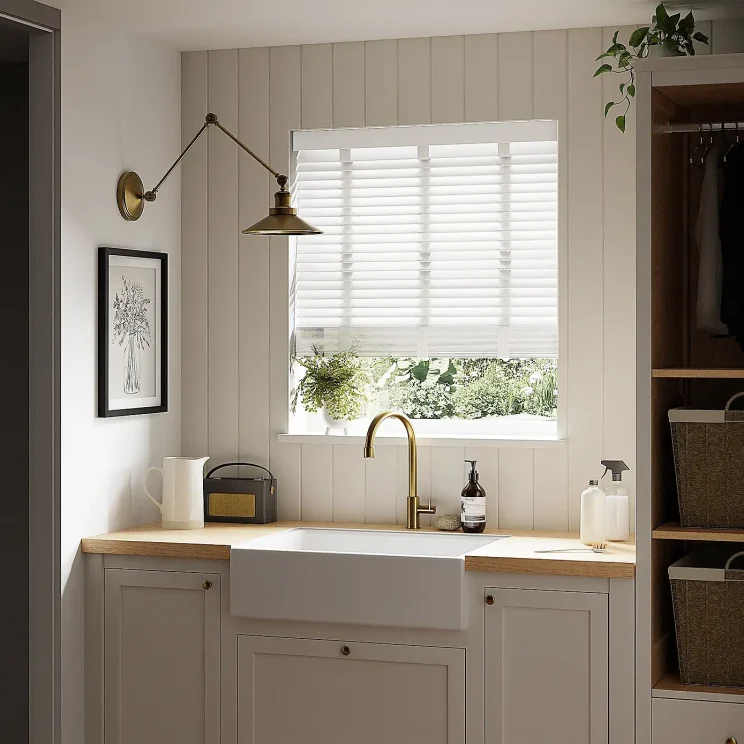
Venetians get a bit of a bad rap, mostly because cheap aluminium ones from the 90s looked awful. But a quality wood or faux-wood venetian, in the right colour, can look genuinely beautiful in a kitchen.
I tend to recommend faux-wood for kitchens specifically. Real wood can warp over time when it’s exposed to humidity and steam, and a kitchen has plenty of both. Faux-wood looks almost identical, costs less, and shrugs off moisture without complaint.
The slat width matters too. Wider slats (50mm or so) feel more contemporary and let in more light when open. Narrower slats give a tidier, more traditional look. Both work; just pick one that matches the rest of the kitchen.
- Best for: Kitchens wanting tilt-control of light
- Watch out for: Real wood warping in humid conditions
- Style fit: Traditional, transitional, modern (in the right colour)
6. Sheer Panels Or Voile
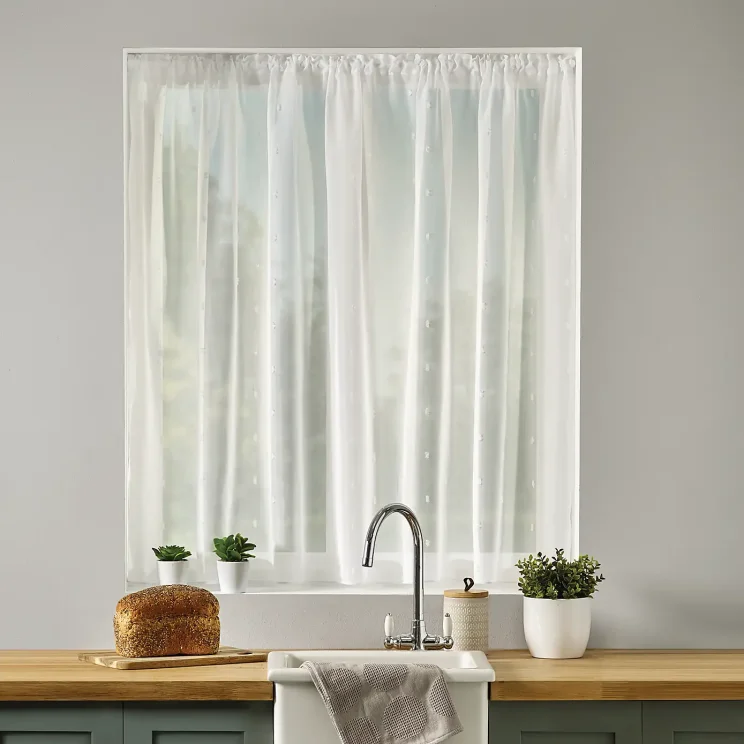
If your kitchen window doesn’t really need privacy but you do want to soften the light, sheer panels or voile can be a lovely option. They diffuse harsh sunlight, knock back glare, and add a layer of softness without darkening the room.
Sheers work especially well in kitchens with tall or oversized windows, where a blind or shutter would feel like overkill. You can hang them as static panels (no draw mechanism, just decorative) or on a track if you want them to actually move.
The catch is that sheers do nothing for evening privacy. The moment your kitchen lights are on, and it’s dark outside, you become a goldfish in a bowl. So they’re often layered with another treatment behind, like a roller blind or shutter, that you can deploy after dark.
- Best for: Daytime light softening; kitchens with no privacy issues
- Watch out for: Zero privacy after dark
- Style fit: Modern, contemporary, Scandinavian, coastal
7. Cellular Or Honeycomb Blinds
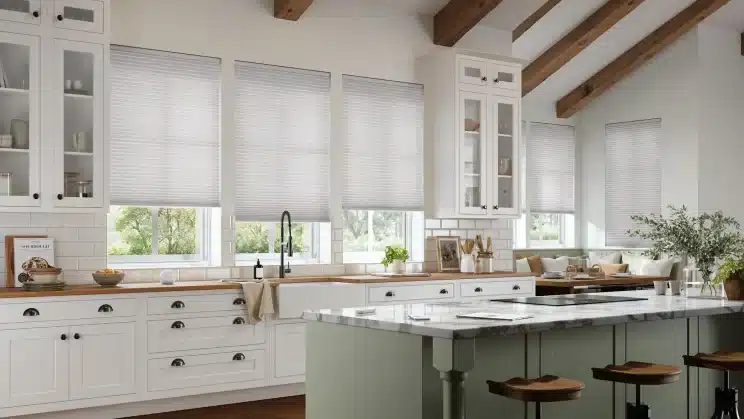
These are less well-known in the UK than in the US, but they’re worth knowing about. The blind is made of pleated fabric in a honeycomb shape, and the air pockets inside actually provide insulation.
For a kitchen, that can be useful. Kitchen windows often sit above sinks, where you’ve got cold draughts in winter and hot direct sun in summer. Cellular blinds help with both. They also come in “top-down/bottom-up” versions, which let you pull the blind down from the top to keep privacy while still letting light in above. Genius for a kitchen window facing the street.
The trade-off is that they’re not the easiest thing to clean. The fabric folds trap dust, and the honeycomb structure can’t really be wiped down properly. So I’d avoid them right next to the hob.
- Best for: Energy efficiency; awkward window positions
- Watch out for: Difficult to clean if they get greasy
- Style fit: Modern, contemporary, transitional
8. Curtains (Full Length Or Sill Length)

Full curtains in a kitchen used to feel old-fashioned, but in open-plan kitchen-diners, they’ve made a real comeback. If your “kitchen” is really part of a bigger living space, treating the windows as living-room windows often makes more sense than reaching for a blind.
Linen curtains, in particular, can look stunning in a more relaxed open-plan space. Hung high and wide, they soften the room, add texture, and tie the kitchen end into the rest of the living area.
Where I’d be careful is in a small, closed-off, working kitchen, especially one with the window near the hob. Long curtains close to a flame are an obvious no, and even electric hobs throw out enough heat and steam to grime them up quickly.
💡 Pro Tip: In open-plan kitchen-diners, hang the curtain pole well above the window frame and extend it 20–30cm beyond either side. It makes the window feel taller and the room feel grander.
- Best for: Open-plan kitchen-diners; large feature windows
- Watch out for: Fire risk and grease near hobs
- Style fit: Classic, traditional, modern country, transitional
9. Window Film (Frosted Or Decorative)
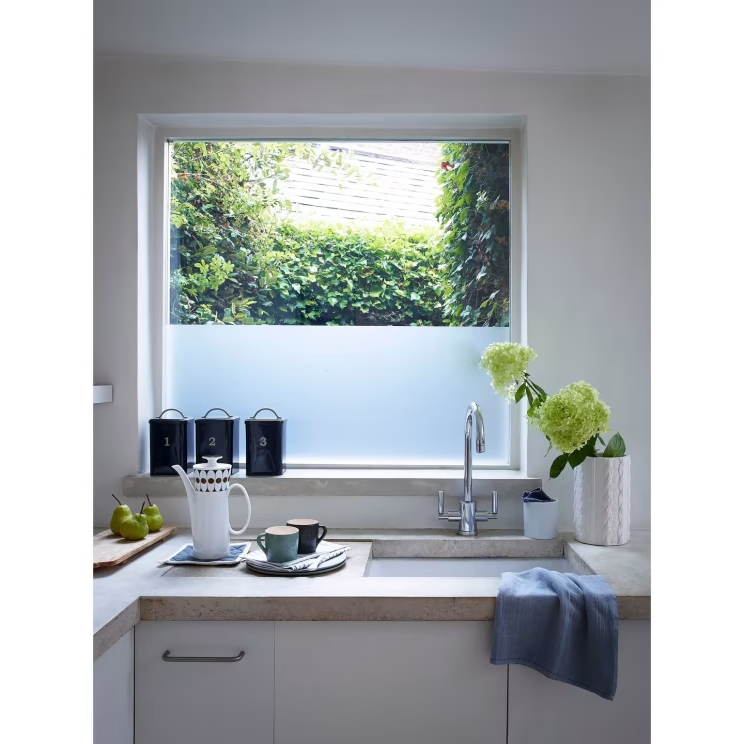
Window film is the sleeper hit of this list. It’s affordable, it’s permanent (or at least, it stays put without effort), and it solves the privacy-versus-light problem with zero hardware on show.
You stick it directly to the glass. Once it’s on, it diffuses the view both ways while still letting plenty of light through. You can get plain frosted, decorative patterns, or even gradient films that frost the lower portion and leave the top clear.
I genuinely like window film for awkward bathroom-adjacent windows and overlooked kitchens where a blind would feel like clutter. It’s also a great option for rentals or as a temporary fix while you decide on something more permanent.
- Best for: Privacy without hardware; tight or awkward windows
- Watch out for: Permanent look; no flexibility once applied
- Style fit: Modern, minimalist, contemporary
10. Leave Them Bare

This isn’t really a treatment, but it’s a legitimate choice, and I see it more and more, especially in newer-build kitchens with clean architectural windows.
If your kitchen is overlooked by nothing but a private garden, why cover the window at all? A bare window lets in maximum light, shows off the frame and view, and gives the room a calmer, less fussy feeling. It also means one less thing to clean.
The catch, obviously, is that this only works if privacy and glare are non-issues. If you’re south-facing and squinting into the sink at lunchtime, you’ll need something. But if you’re lucky enough to have a window that doesn’t need anything? My advice would be to leave it alone and enjoy it.
- Best for: Private outlooks; architectural windows
- Watch out for: Glare on south-facing aspects
- Style fit: Modern, minimalist, contemporary
Quick Comparison
| Treatment | Cleanability | Privacy Control | Light Control | Best For |
|---|---|---|---|---|
| Roman blinds | Low | Good | Good | Style-led kitchens |
| Roller blinds | High (PVC) | Good | Good | Modern kitchens |
| Café curtains | Medium | Eye-level only | Limited | Street-facing kitchens |
| Shutters | High | Excellent | Excellent | Long-term homes |
| Venetian (faux wood) | High | Good | Excellent | Tilt control |
| Sheers | Low | Daytime only | Soft diffusion | Tall windows |
| Cellular | Low | Good | Good | Insulation |
| Curtains | Low | Excellent | Good | Open-plan diners |
| Window film | High | Good | Soft diffusion | Awkward windows |
| Bare | N/A | None | None | Private outlooks |
Final Thoughts…
Window treatments are one of those finishing touches that can either lift a kitchen or quietly let it down. The good news is, there’s no single right answer. The best choice depends on your light, your layout, your style, and how realistic you are about cleaning fabric near a cooker.
If I had to give a starting point, I’d say roman blinds for traditional kitchens, roller blinds for modern ones, and shutters if the budget can stretch. But honestly? The right answer is whichever one you’ll still love three years from now, when the kitchen is fully lived in, and the novelty has worn off.
Take your time with this one. Window treatments are easy to change later, but they’re also one of the small details that make a kitchen feel properly finished.
FAQs
What’s the best window treatment for a window directly above the sink? A wipeable roller blind or plantation shutters are usually best. You’ll be reaching across the window constantly, so you want something that pulls up out of the way easily and shrugs off splashes. Avoid heavy fabric and long curtains here.
Are curtains a fire risk in kitchens? Curtains close to a gas or electric hob can absolutely be a fire risk, especially long ones near a flame. If you want curtains in a kitchen, keep them well away from the cooker, or restrict them to open-plan kitchen-diners where the cooking zone is at the other end of the room.
Do shutters work well in kitchens with a lot of steam? Generally, yes. Especially MDF or hardwood shutters with a moisture-resistant finish. They don’t absorb steam the way fabric does, and they wipe clean easily. Just check with the manufacturer that the shutters are suitable for humid environments before you order.
Can you fit blinds inside the window recess? Yes, and it’s often the neatest look. Blinds fitted inside the recess sit flush with the window, leaving the windowsill clear, and giving you a clean architectural finish. Just measure carefully because there’s no margin for error with recess fits.
How much do plantation shutters cost in the UK? Costs vary widely depending on size, material, and supplier, but expect somewhere in the region of £250–£450 per square metre installed for mid-range made-to-measure shutters, with premium hardwood ranges climbing higher. Get at least two or three quotes, as pricing between suppliers can vary a lot.
Are window films easy to remove? Most modern static-cling and adhesive films can be removed without damaging the glass, though adhesive ones may leave residue that needs a glass cleaner to lift. If you’re worried about commitment, go for a static-cling film, which peels off cleanly when you’re done.
DISCOVER MORE
- Kitchen Window Treatments – 10 Popular Options To Consider

- 10+ Ways To Create Extra Counter Space In Your Kitchen
- Floating Kitchen Shelves – Ideas, Advice & Expert Tips



Author

Michael is a kitchen designer from the UK. He's been designing and project managing new kitchen installations for over 10 years. Before that, he was an electrician and part of a team that fitted kitchens. He created Kitchinsider in early 2019 to help give people advice when it comes to getting a new kitchen.