Open Shelving Or Glass-Fronted Cabinets? – Pros, Cons & Advice
Open shelving and glass-fronted cabinets tackle the same design problem from different angles. They’re both ways to break up a heavy run of solid cabinets, and let your kitchen feel a little more open, a little more curated, and a little more you.
But which one is actually right for your kitchen? And honestly, are either of them as practical as Instagram makes them look?
In this post, I’ll walk you through the real pros and cons of each, when one tends to work better than the other, and how to decide if either is the right move for your space.
In a hurry? Here’s my key takeaway:
🪟 Open shelving feels lighter and more relaxed but demands styling and dusting. Glass-fronted cabinets give you a similar visual lift with far less day-to-day upkeep. For most homeowners, glass is the more practical option, but open shelves win when you genuinely love to style.
Read on to learn more…
You May Also Like
Kitchen Without Upper Cabinets – Advice, Ideas & Practicalities
What’s the Difference, Really?
It sounds obvious, but the two are often lumped together as the “alternative to solid wall cabinets”, and they actually behave quite differently in real homes.
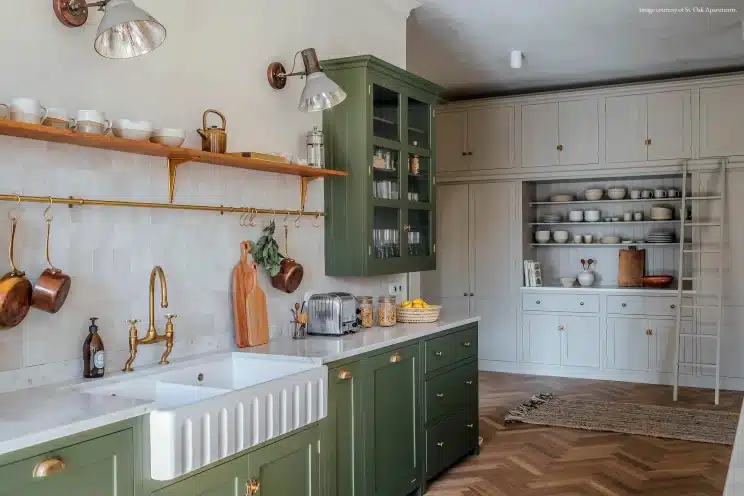
Open shelving is exactly what it sounds like. A floating shelf, a bracketed shelf, or a countertop ledge. No doors, nothing in the way. Whatever you put on it is on full display, all the time.

Glass-fronted cabinets still have a cabinet box and a door. The door just happens to be glass (clear, fluted, ribbed, or smoked). Contents are visible, but they’re protected from dust, grease, and the general chaos of a working kitchen.
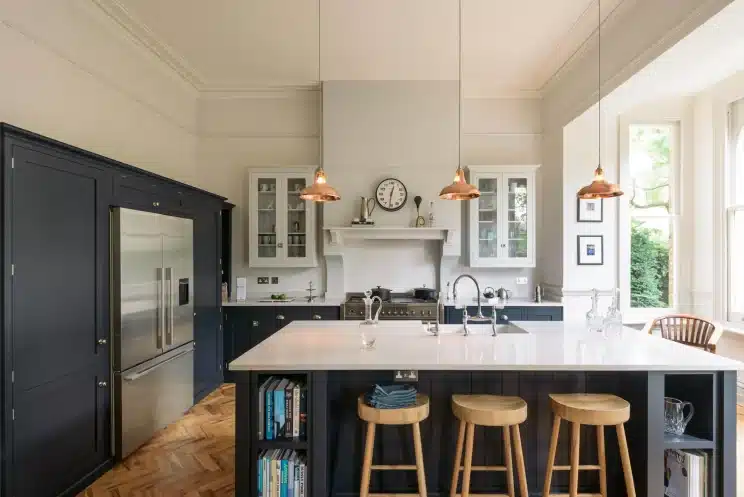
Both achieve a similar goal of breaking up a wall of solid doors and letting the eye breathe. But the trade-offs are genuinely different, and it’s worth knowing what you’re signing up for before you commit.
The Pros of Open Shelving
1. Lightness and Openness
Open shelving is the lighter of the two. With nothing in front of your contents and no cabinet box behind them, the wall behind the shelf becomes part of the design. You can see your splashback, your wall colour, and your tiles. Especially in smaller kitchens, this can make the whole room feel taller and less boxed in.
2. A Chance to Show Off Your Taste
If you’ve collected nice ceramics, glassware, cookbooks, or even just a beautiful set of wooden boards, open shelves give you a reason to display them. Done well, they add personality and warmth that no closed cabinet can offer.
3. Easy Reach
There’s no door to open, no handle to pull. For everyday items like your favourite mugs, daily glassware, and a stack of bowls, that little bit of friction removed makes a real difference. Especially for shorter cabinets, where reaching up to open a door can be awkward.
4. Often Cheaper
Open shelves are usually cheaper than the equivalent run of cabinets. If you’re trying to stretch your budget, swapping a few uppers for a couple of nice timber shelves is one of the easier savings to make.
The Cons of Open Shelving
1. Dust, Grease, and Cleaning
This is the big one, and it’s worth being honest about. Kitchens generate dust, cooking residue, and grease, and all of it settles on whatever you leave out on a shelf. Plates that sit untouched for a week will need rinsing before you use them. Glassware will be dustier than you’d like.
If you’re a busy household and you don’t fancy adding “wipe down the shelves” to your routine, open shelving can quickly stop feeling charming.
2. The Styling Pressure
Pinterest open shelves are styled. Real open shelves often look like… open shelves. Mismatched mugs, the kids’ water bottles, a half-empty bottle of olive oil. There’s nothing wrong with any of that, but if you want your shelves to look like the magazines, you have to actively style them and re-style them whenever something gets used.
3. Less Storage Per Run
A standard wall cabinet holds more than the same width of open shelving, simply because cabinets typically have multiple shelves inside, and you can stack things higher without it looking cluttered. If storage is tight, open shelving can cost you.
4. Weight Limits
Floating shelves, in particular, have weight limits. Pile too many heavy plates on them, and you risk sagging, or worse, the whole shelf coming away from the wall. It’s not a deal-breaker, but it’s worth choosing your shelves and fixings carefully.
💡 Pro tip: If you’re going for floating shelves, ask your installer about the wall type before you commit. Plasterboard walls without solid backing need specific fixings, and not every shelf will support them.
The Pros of Glass-Fronted Cabinets
1. The Best of Both Worlds
Glass-fronted cabinets give you that lighter, more open visual feel without exposing your contents to the kitchen. You still see what’s inside, but it’s behind a door. Protected from dust and grease, and easier to keep looking good.
2. Internal Lighting Becomes a Feature
This is one of my favourite design moves. Add a discreet LED strip inside a glass-fronted cabinet, and suddenly you have a soft, atmospheric glow that lifts the whole kitchen, especially in the evenings. Open shelves can’t really replicate this. The light just spills everywhere.
3. Far More Forgiving
You don’t have to “style” a glass cabinet. As long as the contents are roughly tidy, the glass softens everything. A stack of nice plates, a few glasses, and a teapot. It all reads as considered, even when it isn’t.
4. Wider Range of Styles
Glass doors come in many forms: clear, fluted, reeded, ribbed, smoked, antiqued, and stained-glass effect. You can match the style to your kitchen. A fluted glass door in a Shaker kitchen feels classic. A flat, clear pane in a handleless kitchen feels modern. There’s a lot more design flexibility here than people realise.
💡 Designer tip: Fluted or reeded glass is a brilliant middle ground. You get the lift of glass-fronted cabinetry without needing to keep the contents perfectly tidy. The texture softens whatever’s behind it.
The Cons of Glass-Fronted Cabinets
1. Slightly More Expensive Than Solid Doors
Glass doors typically cost a little more than solid timber or painted MDF doors, especially if you go for textured or decorative glass. It’s not a huge premium, but it’s worth budgeting for.
2. Fingerprints and Smudges
Clear glass shows every print, especially around the handle area. If you’ve got young children at handle-height, you’ll be reaching for the glass cleaner more often than you’d like. Textured or fluted glass hides this far better.
3. The Inside Still Needs to Be Tidy
You can’t fill a glass cabinet with random kitchen mess and expect it to look good. The contents are visible, even if they’re protected. You don’t need to style a glass cabinet, but you do need to keep it from looking chaotic.
You May Also Like
Subtle Design Choices That Make A Kitchen Feel Expensive
When Open Shelving Wins
There are kitchens where open shelving genuinely is the better call:
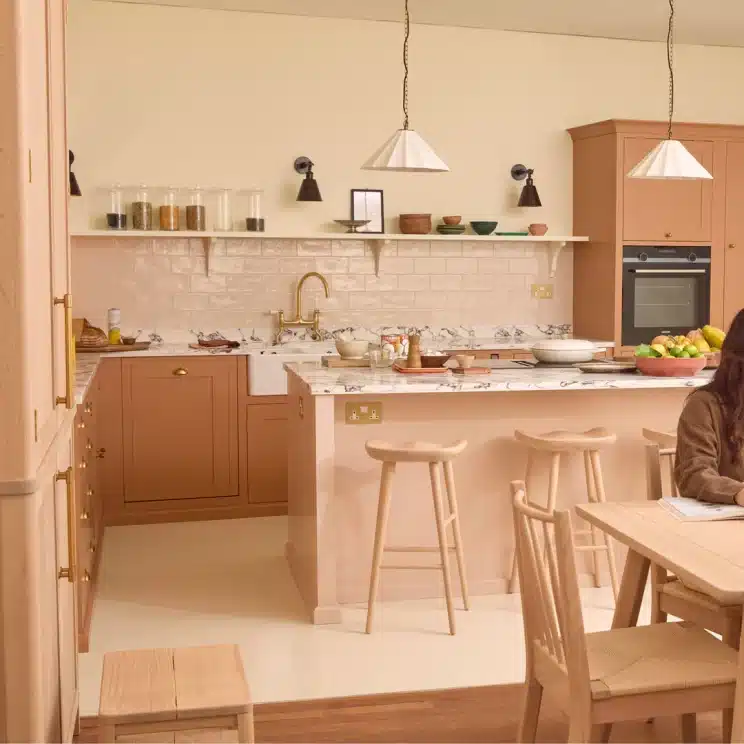
- You actively enjoy styling. If you find rearranging shelves relaxing rather than annoying, open shelves give you a creative canvas that a glass cabinet never can.
- You have a small kitchen and need every visual trick. Open shelves make a small space feel bigger, more dramatically than glass cabinets do.
- Your splashback or wall feature deserves to be seen. If you’ve spent money on beautiful tiles, slabs, or panelling, open shelving lets that wall keep doing the work.
- You only need a small amount of accessible storage. A single shelf for everyday mugs, or a countertop ledge for oils and seasonings, is a lovely targeted use of open shelving without committing to a whole wall of it.
When Glass-Fronted Cabinets Win
For most homeowners, in my experience, glass-fronted cabinets end up being the more practical choice. They’re worth a serious look if:
- You want the lighter feel without the maintenance. Glass softens a wall of cabinets without adding cleaning to your weekly routine.
- You like the idea of feature lighting. Internal LED strips behind glass doors look beautiful and are surprisingly affordable to add.
- You’re not confident in styling. If you want the kitchen to look “designed” without having to curate it, glass is much more forgiving.
- You have a busy family life. A working family kitchen is rarely styling-ready at any given moment. Glass lets things still feel ordered even when the shelf inside isn’t perfect.
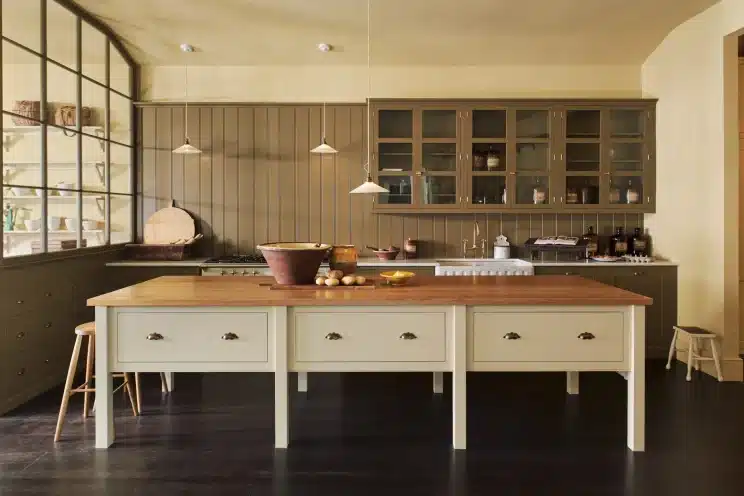
💡 Pro tip: You don’t have to choose just one. A single run of glass-fronted cabinets plus one carefully placed open shelf, say, above a coffee station or behind the sink, gives you the lift and personality of open shelving without committing the whole kitchen to it.
Can You Use Both?
Honestly, this is what I’d suggest for most kitchens. The most successful kitchens I see don’t pick one and run with it. They mix and match.
You might have your main run of upper cabinets in solid doors for storage, then break it up with a glass-fronted cabinet at one end (with internal lighting) and a single open shelf or countertop ledge above the worktop for everyday mugs and oils.
That mix gives you the practical storage of solid doors, the design lift of glass, and the personality of open shelving, without forcing any single feature to do too much work.
You May Also Like
Should Kitchen Cabinets Go To The Ceiling? – Pros, Cons & Expert Tips
Final Thoughts
Both open shelving and glass-fronted cabinets can completely change the feel of a kitchen, in their own ways. Open shelving is the more striking move, but it asks more of you in return. Glass-fronted cabinets are the more forgiving option, and for most homeowners, the more practical one.
In my experience, the best kitchens use a little bit of both. Letting each one do what it does best, without asking either to carry the whole design.
If you’re planning a kitchen now and feeling drawn to one or the other, the honest question to ask yourself is: Am I going to keep this looking the way I want it to in two years’ time? If the answer is yes, go for it. If the answer is “probably not,” you’ve got your answer there, too.
FAQs
Are open shelves more practical than upper cabinets? Not for most people. Open shelves give you a lighter look, but you’ll lose storage capacity and gain cleaning. They’re best used selectively rather than as a full replacement for upper cabinets.
Is glass-fronted cabinetry old-fashioned? Not at all. Modern glass options like fluted, reeded, or smoked glass feel very current, and clear glass with internal lighting is a staple of contemporary high-end kitchens. The style of the door frame matters more than the glass itself.
Do open shelves really get that dusty? Yes, more than people expect. Kitchens generate cooking grease that mixes with dust and settles on every surface. If items aren’t used regularly, they’ll need a wipe before use.
Can I add glass doors to existing cabinets? Sometimes, yes. If your cabinet doors are a standard size and removable, your kitchen supplier may be able to swap them for glass equivalents. It’s worth asking before you commit to a full refit.
Should I use open shelving in a small kitchen? It can work brilliantly in a small kitchen because it makes the space feel larger. Just be selective. One or two shelves rather than a whole wall, so you don’t lose the storage you need.
DISCOVER MORE
- The Cosy Kitchen Comeback – Moving Away From Open-Plan

- Why The Perfect Kitchen Doesn’t Exist
- Open Shelving Or Glass-Fronted Cabinets? – Pros, Cons & Advice

Author

Michael is a kitchen designer from the UK. He's been designing and project managing new kitchen installations for over 10 years. Before that, he was an electrician and part of a team that fitted kitchens. He created Kitchinsider in early 2019 to help give people advice when it comes to getting a new kitchen.